Using AI during a course
AI-based text-generating tools such as ChatGPT can not only be used by students to support their learning process, but also hold great potential for teachers. This is because on the one hand, they can make course planning more efficient, and on the other hand, they can be used in courses a didactically meaningful way. This article describes possible application scenarios of AI-based tools in courses.
For a didactically sensible use of AI-based tools, it is advisable to be guided by the concept of constructive alignment, which means the alignment of learning outcomes, examination task(s) and teaching/learning activities. Against this background, you as a teacher should critically examine whether the use of AI-based tools during teaching/ learning activities makes sense with regards to the learning outcomes and the examination.
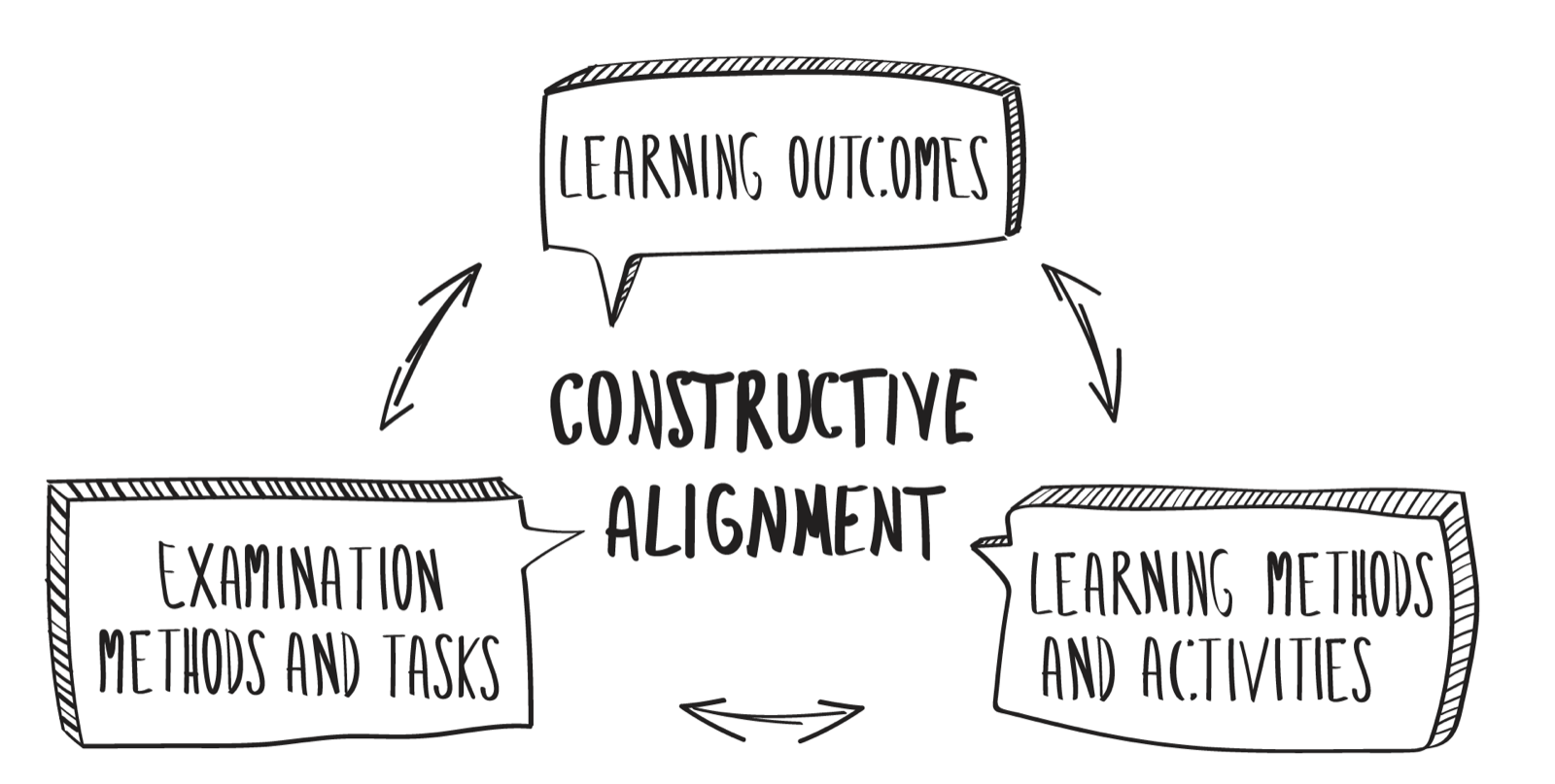
- If tasks in the assessment have to be completed without AI-based tools, it can make sense to also do the relevant exercises in class without the use of AI. This can be done in a flipped classroom setting, for example.
- If the use of AI-based tools contributes to the achievement of the subject-specific learning outcomes, or if the use of AI-based tools is allowed in the exam, it is also sensible to use them during the learning process. In addition to the verifiable learning result, it is also advisable to document and reflect on not only the result, but also on the process of working on the task with AI-based tools and, if desired, to include this in the grade.
The following examples show how using AI-based tools can support the didactic-methodological design of your course.
To help students acquire subject-specific competences, your students can use AI-based tools to:
- have texts summarised and analysed
- create exercises, self-assessments and exam questions on the content
- create and evaluate possible solutions for tasks
- develop arguments for different points of view in discussions
- write code and have it explained
- check code they have written themselves
- translate code into another programming language
To help your students acquire competences related to AI (AI Literacy), your students could do the following:
- compare the output of AI-based tools for a specific prompt with scientifically approved knowledge and have its quality evaluated
- compare the output of AI-based tools for a specific prompt with a solution created by humans
- have the output of AI-based tools checked with regard to truth, bias and hallucination
- create prompts for various tasks, check and improve them
- create texts with the help of AI-based tools, taking into consideration principles of good scientific practice
In order to receive good results from your prompts, the following suggestions might be helpful:
- have ChatGPT take on the role of a person (e.g. teacher of subject XY)
- clearly describe the task/goal to be done and specify sub-steps
- describe the context and possible conditions or limitations as precisely as possible
- describe the desired output format (e.g. giving examples

- Category
- Didactics
- Published
- Updated
- Authors
- TU Graz Teaching Academy